
I. Project Background
A border defense unit stationed on a high-altitude plateau operates in an area above 4,500 meters, characterized by mountainous and desert terrain, extreme daily temperature fluctuations (-15°C to 25°C), and thin air. During squad patrols and tactical missions, three major challenges were identified:
The complex plateau terrain restricted troop mobility. When encountering sudden enemy contact, the deployment of supporting firepower was slow, often leaving units in a vulnerable position.
Traditional individual heavy weapons, like light machine guns weighing over 10 kg, imposed a significant burden. The physical strain of carrying this load at high altitude rapidly depleted soldiers' energy, reducing sustained combat effectiveness.
Soldiers faced high exposure risks during close-quarters engagements. A 2023 tactical exercise resulted in simulated casualties highlighting this vulnerability.
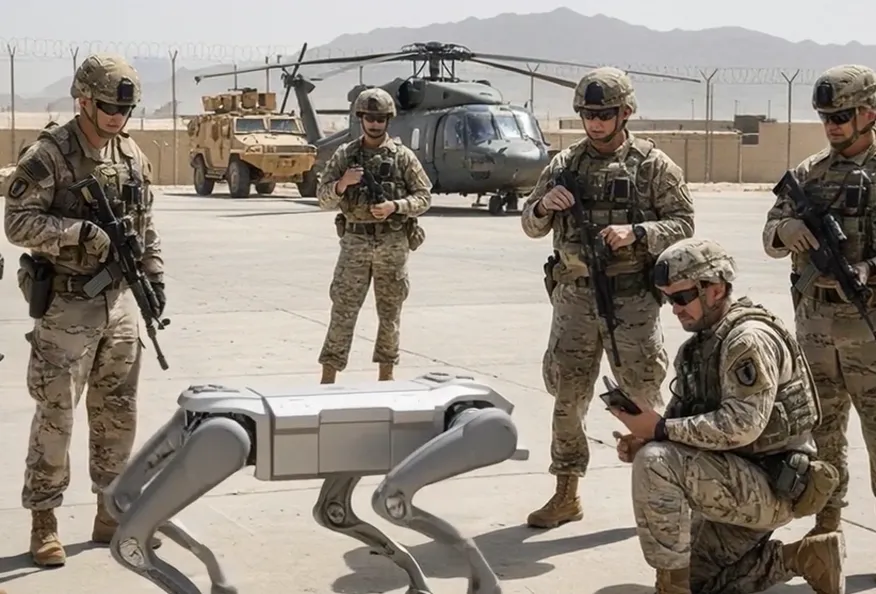
To enhance squad-level fire support capability and improve soldier safety in high-altitude operations, the unit equipped eight squad fire support robotic dogs in April 2024 for tactical training and operational deployment.
II. Implementation Process
1. Adaptation and Deployment (April 5 – April 20)
The technical team modified the robotic dogs for the high-altitude environment and tactical requirements:
Armament: Mounted with a lightweight universal weapon station compatible with systems like the Type 95 light machine gun and grenade launchers. It features automatic targeting and remote-controlled firing with an effective range of 800 meters.
Power System: Equipped with a plateau-optimized power system and enhanced batteries, providing over 6 hours of continuous operation in low-temperature, high-altitude, low-oxygen conditions.
Communication: Integrated tactical comms modules for seamless linkage with squad personal radios, supporting voice command control and real-time tactical data transmission.
Protection: Fitted with ballistic armor capable of withstanding close-range 7.62mm rifle fire to ensure survivability.
Using the patrol routes and exercise area topography, a 3D tactical map was created. Two core tactical modes were established: "Squad Guidance + Robotic Dog Fire Cover" and "Remote Control + Autonomous Strike." Integration with the unit's tactical command system was completed.
2. Tactical Exercises and Debugging (April 21 – May 10)
Twelve high-altitude tactical integration exercises were conducted, simulating real-world scenarios such as "ambush during border patrol," "mountain assault/defense," and "strongpoint defense."
Two core capabilities were optimized during these drills:
Mobility: Enhanced high-altitude terrain navigation through optimized limb joint drives, enabling traversal of 50° slopes, crossing 1-meter obstacles, and stable movement on rocky desert ground.
Accuracy: Improved firing precision by integrating a plateau ballistics correction algorithm. This system automatically adjusts aim based on environmental parameters like wind speed and altitude, increasing hit accuracy from 82% to 95%.
Concurrently, soldiers completed tactical coordination training with the robotic dogs, achieving a squad command response time of one second or less.
3. Operational Deployment (May 11 – Present)
The eight squad fire support robotic dogs were integrated into patrol squads, routinely accompanying them on missions. For tactical operations, they are armed based on mission requirements, typically following a "one squad, two dogs" configuration.
During engagements, they can be remotely fired by soldiers or operate autonomously based on pre-set tactical rules to provide covering fire or engage targets. They simultaneously transmit real-time battlefield footage and engagement data to the tactical command system.
III. Application Results
Significantly Enhanced Fire Support: The time for a squad to deploy effective firepower was reduced from 5 minutes to 1 minute. Response speed for fire suppression during unexpected enemy contact improved by 80%. The robotic dogs' 6-hour continuous operation provides sustained firepower output far exceeding individual soldier capability.
Reduced Soldier Burden: Individual soldier load was reduced by 10-15 kg. Physical exhaustion during high-altitude marches decreased by 40%, boosting squad endurance by 50%. By having robotic dogs assume close-quarters fire engagement roles, soldier exposure risk was lowered by 90%.
Optimized Tactical Synergy: A cohesive "Soldier + Robotic Dog" integrated tactical mode was achieved, leading to more precise and efficient command responses. In multiple 2024 exercises, squads equipped with robotic dogs achieved a 100% mission success rate, reducing simulated casualty rates to zero.
IV. Typical Scenario
On July 20, 2024, a patrol squad on the high-altitude border simulated an encounter with a "sudden attack by illegal armed elements." The squad leader immediately issued a "covering fire" order. Two squad fire support robotic dogs quickly occupied elevated positions on both flanks, automatically locked onto three simulated targets, and completed firing solutions using the plateau ballistics correction algorithm.
The squad leader remotely commanded the robotic dogs to open fire via his personal radio. Within 10 seconds, two targets were accurately neutralized. The remaining target was suppressed by continuous fire from the robotic dogs, preventing any offensive action. Simultaneously, the robotic dogs streamed live battlefield footage to the command system, guiding rapid reinforcement to the scene.
During this exercise, the robotic dogs' rapid mobility and precise firepower enabled the squad to neutralize the threat within 15 minutes, with zero risk of personnel exposure. This fully validated their value in high-altitude integrated tactical operations.
 RELATED
 RELATED
 RELATED
 RELATED
Ce site Web utilise des cookies pour vous garantir la meilleure expérience sur notre site Web.

 English
 Español
 Pусский
 العربية






 Téléphone
Commentaire
(0)