
I. Project Background
A state-owned key coal mine’s No. 3 underground mining face, located at a depth of 820 meters, comprises a total tunnel length of 12 kilometers across six functional zones, including excavation, transportation, and ventilation areas. The area faces multiple safety hazards such as fluctuating gas concentrations, roof collapse risks, and potential transport collisions. Previously, the mine employed a shift-based manual inspection model involving “2 inspectors + 1 safety officer” per team, with each inspection round taking 4 hours. This approach presented several critical issues:
When gas concentrations exceeded safe limits (≥1% VOL), inspections had to be suspended, leading to delayed coverage in certain areas. In 2023, undetected gas accumulation in an excavation zone caused a partial explosion, resulting in equipment damage.
Manual inspections required carrying multiple detection devices, and traveling through tunnels with slopes up to 15 degrees led to high physical fatigue and a miss rate of 12%. In one instance, an undetected loose rail joint caused a mine cart to derail.
Unstable underground communication signals meant that after identifying hazards, personnel had to run to communication points to report, resulting in an average response time of over 30 minutes.
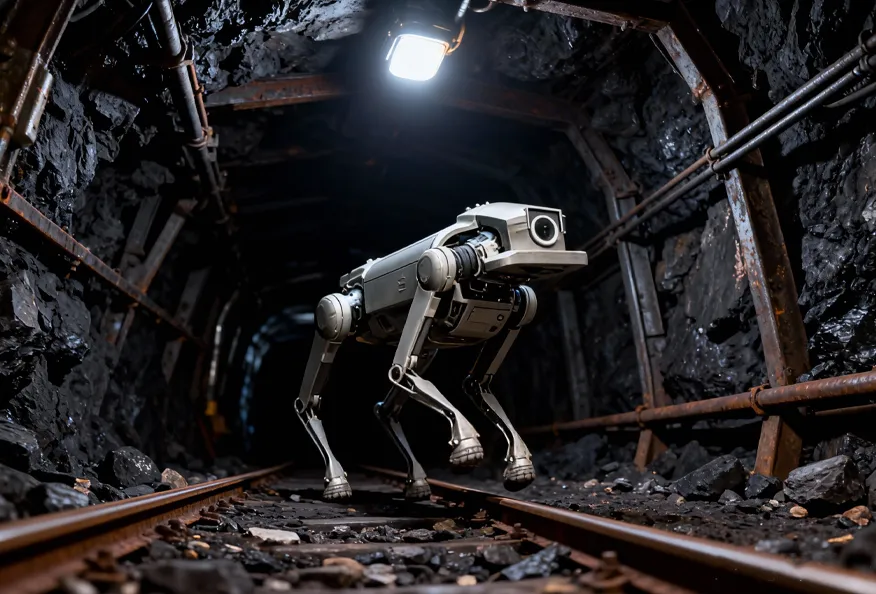
To enhance underground safety management, the mine introduced two specialized mining patrol robotic dogs in March 2024.
II. Implementation Process
1. Preliminary Adaptation and Deployment (March 10 – March 25)
The technical team carried out mining-specific explosion-proof modifications on the robotic dogs, replacing their casings with flameproof aluminum alloy materials and upgrading sensors to intrinsically safe mining-grade standards, certified by the National Coal Mine Safety Administration. Using LiDAR from the robotic dogs combined with existing underground survey data, a 3D tunnel map was constructed with 1,800 risk points. Three patrol routes were predefined (excavation zone line, transportation zone line, and comprehensive inspection line), along with 12 safety thresholds—such as gas concentration alerts at ≥0.8% VOL and roof displacement warnings at ≥5 mm. Data interoperability was established with the underground personnel positioning system and gas monitoring system.
2. Trial Operation and Debugging (March 26 – April 15)
A “robotic dog patrol + manual verification” model was adopted. The robotic dogs performed three daily patrol shifts (8:00 AM, 2:00 PM, and 8:00 PM), with each patrol lasting 2.5 hours. During the trial phase, two key issues were resolved:
Excessive dust in the tunnels caused camera blurring. After installing automatic dust-removal wipers and anti-fog coating, image recognition accuracy improved from 82% to 98%.
Weak signals in certain curved tunnel sections were addressed by deploying underground 5G repeaters and optimizing Beidou positioning algorithms, achieving full communication coverage.
3. Formal Operation (April 16 – Present)
The two robotic dogs are now responsible for patrolling the eastern and western tunnel sections respectively. They conduct real-time monitoring of eight parameters, including gas concentration, roof displacement, and rail condition. All data is synchronized to the ground dispatch center, with anomalies automatically triggering audible and visual alarms and pushing location-based alerts.
III. Application Results
1. Enhanced Safety Prevention Capabilities:
Achieved 24/7 uninterrupted gas concentration monitoring, reducing warning response time to within 10 seconds.
In 2024, the system successfully issued early warnings for 4 abnormal gas concentration incidents and 3 cases of excessive roof displacement, preventing major safety accidents.
Rail inspection coverage increased from 85% to 100%, and equipment failure downtime decreased by 60%.
2. Significant Reduction in Labor Costs:
Three inspection shifts were eliminated, saving approximately 1.56 million RMB annually in labor costs.
The robotic dogs can operate in critical gas concentration zones (0.8%–1% VOL), covering inspection blind spots and achieving 100% safety management coverage.
3. Improved Management Efficiency:
Automated daily safety inspection reports are generated, with historical data available for traceability and analysis.
This has helped the mine identify three high-frequency risk points in the excavation zone and complete necessary upgrades, raising the hazard rectification rate from 78% to 95%.
 RELATED
 RELATED
 RELATED
 RELATED
Ce site Web utilise des cookies pour vous garantir la meilleure expérience sur notre site Web.

 English
 Español
 Pусский
 العربية






 Téléphone
Commentaire
(0)