
I. Project Background
A national-level high-tech industrial park spans 2.8 square kilometers and houses 42 enterprises, 12 R&D buildings, 3 large parking lots, and 2 kilometers of perimeter fencing. The park experiences a daily flow of over 5,000 personnel and 1,200 vehicles. Previously, the security model relied on “8 security guards + 10 fixed cameras,” which had notable limitations:
During the vulnerable night period (10:00 PM to 6:00 AM), manual patrols were prone to fatigue. In 2023, three hit-and-run vehicle incidents occurred and remained unsolved.
Numerous blind spots existed in corners and greenbelt areas, leading to past thefts of outdoor AC units from R&D building exteriors.
Visitor registration relied on manual verification at gates, resulting in low efficiency and frequent missed registrations.
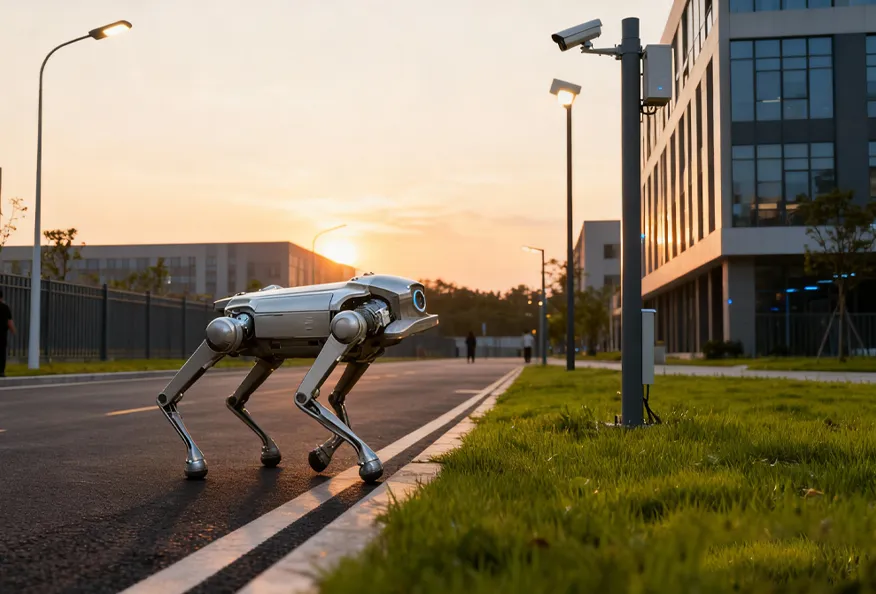
To establish a “Smart Security + Efficient Management” system, the park management committee introduced four intelligent security patrol robotic dogs in January 2024.
II. Implementation Process
1. System Setup and Deployment (January 8 – January 22)
The technical team integrated the robotic dogs into the park’s smart management platform, enabling data connectivity with the access control system, surveillance system, and parking management system. Using LiDAR to scan the park environment, an electronic map was created, marking 28 key security zones and 16 surveillance blind spots. Four patrol routes were predefined:
Perimeter fence line
R&D zone loop
Residential zone loop
Parking lot dedicated line
Alert rules were configured, including a facial recognition blacklist (containing 5 individuals reported as suspicious within the park) and alerts for vehicles parked abnormally (exceeding 30 minutes).
2. Trial Operation and Optimization (January 23 – February 15)
A patrol mechanism of “2 robotic dogs during day shifts, 2 during night shifts” was implemented. Day shifts focused on verifying visitors and vehicles, while night shifts prioritized hazard detection. During the trial, three functions were optimized:
Low facial recognition accuracy under insufficient nighttime lighting was improved to 99.3% after adding infrared fill lights.
Obstacle avoidance success rate increased to 98.5% by adjusting LiDAR angles and adding visual-aided recognition to address interference from weeds in greenbelts.
Visitor verification was streamlined: robotic dogs could scan visitor QR codes on-site and sync data with the gate system, enabling “front-end verification + back-end recording.”
3. Formal Operation (February 16 – Present)
The robotic dogs now perform fully autonomous security patrols:
Day shifts: patrol every 2 hours
Night shifts: patrol every hour
Abnormal incidents are reported in real-time to the park’s security command center and security guards’ mobile apps.
III. Application Results
1. Comprehensive Security Coverage with Zero Blind Spots:
Surveillance coverage of blind spots increased from 0% to 100%.
Since 2024, no thefts, hit-and-run incidents, or similar security events have occurred.
Nighttime emergency response time shortened from 15 minutes to 3 minutes, leading to a 100% reduction in security incidents.
2. Significant Improvement in Management Efficiency:
Visitor verification efficiency improved by 60%, reducing average gate queue time from 5 minutes to 1 minute.
Robotic dogs automatically log patrol data and generate daily security reports, boosting security management efficiency by 40%.
3. Reduction in Operational Costs:
Four security guard positions were eliminated, saving approximately 640,000 RMB annually in labor costs.
Intelligent early warnings prevented property losses exceeding 800,000 RMB (e.g., timely detection of blocked fire exits in R&D buildings and vehicles left running in parking lots).
IV. Typical Scenario
At 2:30 AM on May 12, 2024, a robotic dog patrolling the perimeter fence detected two unregistered individuals climbing over the fence into the park from the southwest greenbelt area. It immediately executed the alert protocol:
Activated blue warning lights on-site and issued a voice alert: “You have entered a restricted area. Please stop immediately.”
Captured clear facial photos and uploaded them to the command center.
Simultaneously pushed location information to night-shift security guards.
Security personnel arrived within 5 minutes. After verification, the individuals were identified as unauthorized scavengers. They were promptly escorted out and registered in the system. Thanks to the robotic dog’s rapid response, potential risks to park property were effectively prevented.
 RELATED
 RELATED
 RELATED
 RELATED
Ce site Web utilise des cookies pour vous garantir la meilleure expérience sur notre site Web.

 English
 Español
 Pусский
 العربية






 Téléphone
Commentaire
(0)