
I. Project Background
A provincial-level modern agricultural demonstration park operates a facility-based agricultural base comprising 20 intelligent greenhouses, covering a total area of 50,000 square meters. The base primarily cultivates high-end fruits and vegetables such as cherry tomatoes and strawberries. Previously, it relied
on a management model of "manual inspection by farmers + traditional hygrothermographs," which presented several pain points:
1. Each greenhouse required one farmer to conduct inspections three times daily, with each inspection taking one hour, resulting in high labor costs and low efficiency.
2. Manual observation of crop growth and pest/disease identification was prone to oversight. In 2023, a delayed detection of tomato late blight led to a 40% yield reduction across three greenhouses.
3. Environmental data such as temperature, humidity, and light levels were manually recorded, making
it impossible to precisely match crop growth needs, leading to a 30% wastage rate of water and fertilizer.
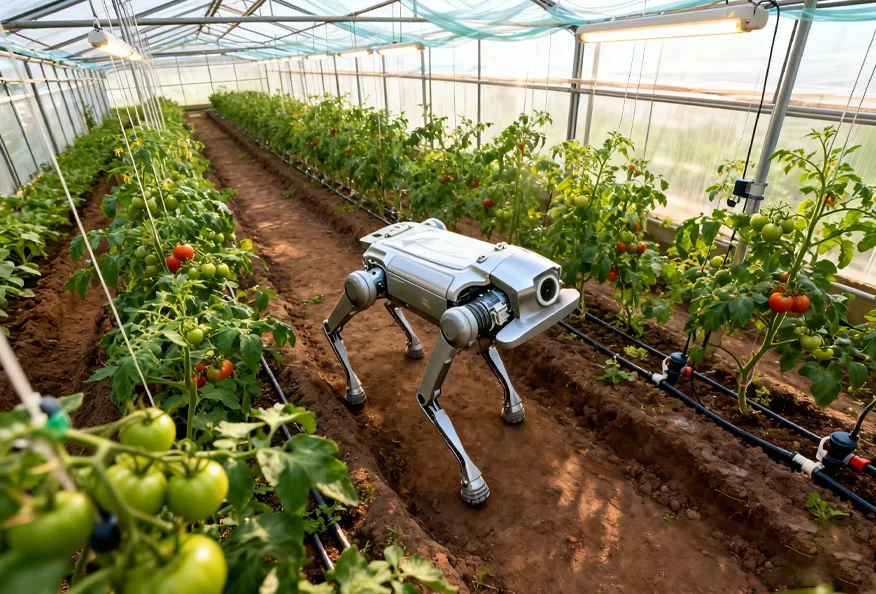
To achieve "precision planting + intelligent management," the base introduced five agricultural greenhouse inspection robotic dogs in February 2024.
II. Implementation Process
1. Scenario Adaptation and Deployment (February 10 – February 25)
The technical team modified the robotic dogs' limb structure to adapt to working in narrow spaces, based
on parameters such as crop row spacing (0.8 meters) and plant height (1.2 meters) within the greenhouses. The robotic dogs were equipped with agricultural-specific multi-spectral cameras (capable of identifying chlorophyll content and pest/disease spots) and synchronized with temperature, humidity, light, and soil moisture sensors. Data connectivity was established with the greenhouse's intelligent water/fertilizer
system and climate control system. By scanning, a 3D map of all 20 greenhouses was constructed. Patrol routes were preset for "inter-row inspection + perimeter environmental monitoring," and environmental parameter thresholds were set for various tomato growth stages (e.g., fruit setting period: temperature 22
–25°C, soil moisture 60–70%).
2. Trial Operation and Debugging (February 26 – March 15)
The robotic dogs implemented a mechanism of "inspecting each greenhouse twice daily," focusing on monitoring crop growth, pests/diseases, and environmental data. During the trial, two key issues were resolved: Data drift from sensors due to the high-humidity greenhouse environment was addressed by installing waterproof breathable covers, improving data accuracy from 85% to 99%. Initial limitations in pest/disease identification by the multi-spectral camera were overcome by optimizing the algorithm model, enabling recognition of 12 common diseases and 8 types of pests with 92% accuracy.
3. Formal Operation (March 16 – Present)
The robotic dogs autonomously conduct greenhouse inspections, uploading real-time crop growth data and environmental parameters to an agricultural cloud platform. Based on this data, the platform automatically generates recommendations for irrigation, fertilization, and climate control adjustments, supporting remote operations by farmers.
III. Application Results
1. Significant Improvement in Cultivation Efficiency:
Pest/disease detection time was reduced from the manual 3–5 days to within 24 hours, improving prevention effectiveness by 80%. In the spring of 2024, tomato yield increased by 25% compared to the same period last year, and the premium fruit rate rose from 75% to 90%. Through precise environmental control, water and fertilizer wastage decreased to 10%, saving approximately 12,000 RMB annually per greenhouse in cultivation costs.
2. Substantial Reduction in Labor Costs:
Eight farmer positions were eliminated, saving about 480,000 RMB annually in labor costs. Inspection time per greenhouse was reduced to 15 minutes per session, increasing inspection efficiency fourfold. 3. Enhancement of Management Precision: A crop growth database was established. Comparative analysis of historical data helped optimize the ideal environmental parameters for cherry tomato growth, providing a scientific basis for future cultivation.
IV. Typical Scenario
At 9:00 AM on April 20, 2024, a robotic dog inspecting Greenhouse No. 7 detected abnormal spectral responses from the leaves of 12 tomato plants using its multi-spectral camera. It immediately captured
high-definition photos and uploaded them to the cloud platform. The system automatically identified the issue as the early stage of tomato early blight. The platform sent an alert and a treatment recommendation (spray with 500-fold dilution of 50% Carbendazim wettable powder) to the cultivation manager. Following
the advice, the manager promptly treated the plants, controlling the disease spread with only 200 RMB in pesticide cost, thereby preventing an estimated 30,000 RMB yield loss. Simultaneously, the robotic dog detected that the greenhouse humidity had reached 85% (exceeding the standard threshold by 10%). The platform automatically instructed the climate control system to activate ventilation mode, reducing
humidity to 70% within one hour.
 RELATED
 RELATED
 RELATED
 RELATED
Ce site Web utilise des cookies pour vous garantir la meilleure expérience sur notre site Web.

 English
 Español
 Pусский
 العربية






 Téléphone
Commentaire
(0)