
I. Project Background
A mountainous region situated within a seismically active zone is characterized by hilly terrain, dispersed villages, and narrow, rugged roads. Earthquakes in this area frequently trigger landslides and building collapses, resulting in blocked roadways and failed communications. Previous rescue operations relied on a "manual search and heavy machinery" model, which presented significant limitations:
Collapsed structures created extremely narrow voids (as small as 20 cm wide) amidst high aftershock risks, directly endangering rescue personnel. During a 2022 earthquake response, two rescuers were injured due to a secondary collapse caused by an aftershock.
Large equipment could not access confined spaces, leading to low efficiency in rescues at smaller collapse sites.
Communication failures disrupted real-time coordination between field teams and command centers, resulting in inefficient allocation of critical resources.
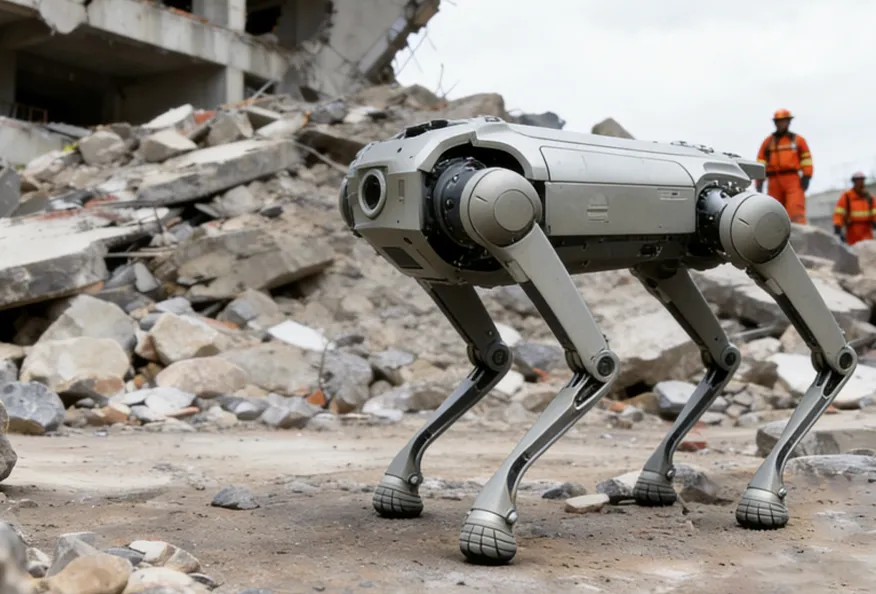
To enhance earthquake emergency response capabilities in such challenging terrain, the local Emergency Management Bureau deployed a fleet of 5 specialized rescue robotic dogs, which became operational in March 2024.
II. Implementation Process
1. Fleet Adaptation and Deployment (March 5 – March 20)
The technical team completed the integrated fleet system. Each robotic unit was equipped with a vital sign detector (capable of sensing human breathing and heartbeat signals within a 50-meter range), a high-definition panoramic camera, emergency lighting, and a satellite communication module to maintain connectivity in network-deprived environments.
The fleet operates on a"1 master + 4 subordinate" collaborative model: the master unit is responsible for overall route planning, data fusion, and liaison with the command center, while the subordinate units execute zoned search patterns and conduct multi-angle reconnaissance. Off-road adaptations included optimized limb joints, enabling the robots to traverse 45° slopes, overcome 80 cm obstacles, and move steadily across unstable rubble. Based on regional topographical data, 8 emergency search routes were predefined, alongside a coordinated rescue protocol (Zone Reconnaissance → Data Sharing → Anomaly Coordination → Precise Localization). Full integration with the emergency command center's satellite communication system was achieved.
2. Simulation Drills and Debugging (March 21 – April 10)
Three comprehensive earthquake rescue simulations were conducted in an abandoned mountain village, incorporating scenarios such as road blockages, communication blackouts, and aftershocks. Key fleet协同 logic was optimized during this phase:
Data Transmission Efficiency: Signal congestion caused by simultaneous data transmission from multiple units was resolved by optimizing data compression algorithms.
Collaborative Navigation: Collision avoidance in narrow areas was enhanced by integrating short-range perception sensors, enabling autonomous and coordinated fleet movement.
Drill results confirmed that in communication-denied, complex terrain, the fleet reduced the average search time per square kilometer from 8 hours (manual) to 2 hours, while achieving a 98% accuracy rate in vital sign detection.
3. Operational Deployment (April 11 – Present)
The fleet is now permanently stationed at the Emergency Rescue Command Center. It can mobilize within 30 minutes of receiving an earthquake alert or rescue order. On-site, the master unit quickly scans the environment and partitions the area into search sectors. The four subordinate units then perform comprehensive, zoned searches, transmitting vital sign data and live video footage to the command center in real-time. Once survivors are located, their positions are marked, and the units provide continuous environmental monitoring to guide rescue teams precisely to the site.
III. Application Results
Significantly Enhanced Search Efficiency: Search time per square kilometer in complex mountainous terrain was reduced from 8 hours to 2 hours, representing a 75% increase in coverage efficiency. During a minor earthquake in 2024, the fleet completed initial searches across three villages within one hour, successfully locating 5 trapped individuals.
Substantially Improved Rescue Safety: By deploying robotic dogs into high-risk rubble zones instead of personnel, the risk of rescuer casualty was reduced by 100%. Operations can continue unabated during frequent aftershocks, eliminating the need to suspend manual searches for safety.
More Precise Resource Allocation: The real-time transmission of on-site data allows the command center to accurately assess disaster conditions, enabling optimal deployment of personnel and equipment. This has improved the utilization rate of rescue resources by 60%.
IV. Typical Scenario
On July 18, 2024, a magnitude 4.8 earthquake struck a mountainous area, causing building collapses in three villages, along with complete road blockages and communication failure. The rescue robotic dog fleet arrived on the scene at 15:30. Following a rapid environmental scan by the master unit, the operational area was divided into Zones A, B, and C, with the four subordinate units dispatched accordingly.
At 16:10, Subordinate Unit #2, operating in Zone B, detected vital signs within the rubble of a collapsed house. It immediately geo-tagged the location and uploaded live footage, revealing a survivor trapped in a debris void. The master unit relayed the precise coordinates to the command center, which guided a team equipped with light rescue gear to the exact site.
The robotic dog maintained continuous environmental monitoring and issued an early warning for an impending aftershock at 16:30, allowing all rescue personnel to evacuate to safety in time. After the aftershock subsided, utilizing the precise location and structural imagery provided by the robotic dog, rescuers successfully extracted the survivor at 17:15. By operating efficiently in a communication-denied, high-risk aftershock environment, the fleet reduced the total rescue time to under two hours, significantly increasing the probability of survival.
 RELATED
 RELATED
 RELATED
 RELATED
Ce site Web utilise des cookies pour vous garantir la meilleure expérience sur notre site Web.

 English
 Español
 Pусский
 العربية






 Téléphone
Commentaire
(0)