
 English
 Español
 Pусский
 العربية
autonomous quadruped robot
Autonomous Quadruped Robot: A Technological Marvel The autonomous quadruped robot represents a groundbreaking advancement in robotics, combining mobility, intelligence, and adaptability to navigate complex environments with remarkable efficiency. Inspired by the biomechanics of four-legged animals, these robots leverage advanced actuators, sensors, and artificial intelligence to perform tasks that were once deemed impossible for machines. Design and Locomotion Quadruped robots are designed with four articulated legs, each equipped with high-torque motors and precision-controlled joints. This configuration enables dynamic movement, including walking, running, climbing, and even recovering from slips or falls. The legs often incorporate compliant mechanisms or passive springs to absorb shocks and improve energy efficiency, mimicking the natural gait of animals. Sensing and Perception Autonomy is achieved through a suite of sensors, including LiDAR, depth cameras, inertial measurement units (IMUs), and force-sensitive footpads. These sensors provide real-time data on terrain, obstacles, and the robot’s own state, enabling it to make split-second decisions. Machine learning algorithms process this data to optimize gait patterns, avoid collisions, and adapt to uneven surfaces like stairs, rubble, or snow. Autonomous Navigation Using simultaneous localization and mapping (SLAM) techniques, the robot builds a 3D map of its surroundings while tracking its position. This allows it to navigate autonomously in GPS-denied environments, such as indoor spaces or disaster zones. Reinforcement learning further enhances its ability to learn from experience, improving performance over time. Applications The versatility of autonomous quadruped robots makes them ideal for diverse applications: - Search and Rescue: Traversing hazardous areas to locate survivors. - Industrial Inspection: Monitoring infrastructure in oil rigs or power plants. - Delivery Services: Transporting goods in urban or remote settings. - Agriculture: Scouting fields or herding livestock. Challenges and Future Directions Despite their potential, challenges remain, such as battery life, cost, and public acceptance. Future advancements may include swarming capabilities, enhanced AI reasoning, and biohybrid designs integrating soft robotics. In summary, autonomous quadruped robots are redefining the boundaries of robotics, blending agility, intelligence, and resilience to tackle real-world challenges with unprecedented sophistication.
Produit
Catégorie:
-
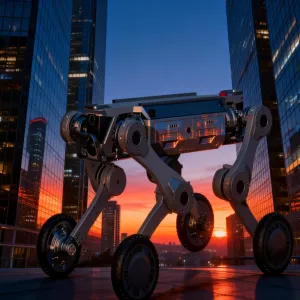
Wheeled Medium-Sized Quadruped Robot – Silent Operation & Low-Light Vision for Sensitive Environments
Leur classification: Veneer DryerVues: 28Numéro:Temps de libération: 2025-12-26 17:02:49Wheeled Medium-Sized Quadruped Robot – Silent Operation & Low-Light Vision for Sensitive Environments
Actualités
Catégorie:
-
[Company News]Wheeled Medium-Sized Quadruped Robot
2025-12-26 11:42:47
Affaire
Catégorie:
Aucun résultat de recherche!
Vidéo
Catégorie:
Aucun résultat de recherche!
Téléchargement
Catégorie:
Aucun résultat de recherche!
Recrutement
Catégorie:
Aucun résultat de recherche!
Produits recommandés
Aucun résultat de recherche!




 Téléphone