
 English
 Español
 Pусский
 العربية
engineering quadruped robot solution
Engineering a Quadruped Robot Solution Designing a quadruped robot involves integrating advanced mechanical, electrical, and software systems to achieve stable, agile locomotion. The key challenges include dynamic balance, energy efficiency, terrain adaptability, and real-time control. Below is an overview of the engineering approach for such a system. Mechanical Design The robot’s structure must be lightweight yet durable, often using carbon fiber or aluminum alloys. Legs typically employ a 3-DOF (degree of freedom) configuration—hip abduction/adduction, hip flexion/extension, and knee flexion/extension—enabling omnidirectional movement. Actuation is achieved via high-torque brushless DC motors or hydraulic systems, depending on payload and speed requirements. Compliant elements like series elastic actuators (SEAs) improve shock absorption and energy efficiency. Locomotion Control Stable gait generation relies on model-based control strategies such as inverse kinematics and dynamics. Central pattern generators (CPGs) create rhythmic motion patterns, while reinforcement learning (RL) optimizes gait parameters for different terrains. For dynamic stability, the system uses an inertial measurement unit (IMU) and force-sensitive resistors (FSRs) to adjust leg trajectories in real time. Perception and Navigation A combination of LiDAR, stereo cameras, and depth sensors enables environment mapping and obstacle avoidance. SLAM (Simultaneous Localization and Mapping) algorithms help the robot navigate unstructured terrain. Machine vision assists in identifying footholds, while deep learning models improve decision-making for complex scenarios. Power and Efficiency Battery life is critical; lithium-polymer or lithium-ion packs are common, with some systems incorporating regenerative braking. Low-power computing (e.g., edge AI processors) reduces energy consumption. Thermal management ensures motors and electronics operate within safe limits. Software Architecture A real-time operating system (RTOS) manages sensor fusion, motor control, and high-level planning. Middleware like ROS (Robot Operating System) facilitates modularity, allowing seamless integration of perception, planning, and actuation modules. Challenges and Future Directions Current limitations include high costs, limited battery life, and robustness in extreme environments. Future improvements may involve hybrid locomotion (e.g., wheels for flat surfaces), advanced materials, and swarm coordination for multi-robot applications. By addressing these aspects, a quadruped robot can achieve reliable, autonomous operation in diverse scenarios, from search-and-rescue missions to industrial inspections.
Produit
Catégorie:
-
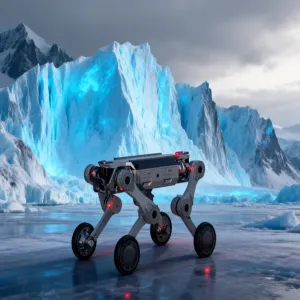
Wheeled Medium-Sized Quadruped Robot – Cloud-Connected Fleet Management and Analytics Dashboard
Leur classification: Veneer DryerVues: 29Numéro:Temps de libération: 2025-12-26 17:08:48Wheeled Medium-Sized Quadruped Robot – Cloud-Connected Fleet Management and Analytics Dashboard
Actualités
Catégorie:
-
[Company News]Key Advantages of the Wheeled Medium-Sized Quadruped Robot
2025-12-26 11:44:56 -
[Company News]Small Wheeled Quadruped Robot
2025-12-26 11:45:35
Affaire
Catégorie:
Aucun résultat de recherche!
Vidéo
Catégorie:
Aucun résultat de recherche!
Téléchargement
Catégorie:
Aucun résultat de recherche!
Recrutement
Catégorie:
Aucun résultat de recherche!
Produits recommandés
Aucun résultat de recherche!




 Téléphone