
 English
 Español
 Pусский
 العربية
compact wheeled quadruped robot
Here is a 500-word description of a compact wheeled quadruped robot: A compact wheeled quadruped robot is a versatile hybrid robotic platform that combines the agility of legged locomotion with the efficiency of wheeled mobility. Designed for dynamic environments, this robot integrates four articulated legs, each equipped with wheels at the feet, enabling seamless transitions between walking and rolling modes. Its compact form factor allows it to navigate tight spaces, making it suitable for applications in urban search-and-rescue, inspection, logistics, and research. The robot’s mechanical structure is built for robustness and adaptability. Each leg features multiple degrees of freedom (DOF), typically three or more, allowing for precise control over movement. The wheels, mounted at the end of each limb, can rotate independently, providing omnidirectional mobility when rolling. This design ensures energy efficiency on flat surfaces while retaining the ability to traverse uneven terrain, stairs, or obstacles by switching to a walking gait. Key to its functionality is the integration of advanced sensors and real-time processing capabilities. The robot is equipped with depth cameras, LiDAR, or stereo vision systems for environment perception, enabling obstacle avoidance, mapping, and autonomous navigation. Inertial measurement units (IMUs) and force sensors provide feedback for balance and gait stabilization, ensuring smooth transitions between different modes of locomotion. Control algorithms leverage machine learning and optimization techniques to adapt the robot’s movement based on terrain conditions. For example, on rough or cluttered surfaces, the robot may prioritize a walking gait, using its legs to step over obstacles. On smooth, open terrain, it switches to wheeled motion for faster and more energy-efficient travel. The ability to dynamically adjust its posture—such as crouching to pass under low barriers or standing tall to extend its sensor range—enhances its operational flexibility. Power efficiency is another critical aspect. The robot’s compact size necessitates lightweight yet high-capacity battery systems, often using lithium-ion or lithium-polymer cells. Regenerative braking during wheeled motion can further extend operational time. Thermal management and low-power electronics help maintain performance during prolonged missions. Potential use cases highlight the robot’s versatility. In disaster response, it can navigate rubble and debris where traditional wheeled or tracked robots fail. For industrial inspections, it can maneuver through complex machinery or confined spaces. In research, its hybrid locomotion serves as a platform for studying adaptive robotics, multi-modal mobility, and human-robot interaction. Future developments may focus on enhancing autonomy, reducing weight, and improving dynamic stability. Advances in materials, actuators, and AI-driven control could lead to even more agile and efficient designs. With its unique combination of legged and wheeled mobility, this compact quadruped robot represents a significant step toward adaptable, multi-functional robotic systems.
Produit
Catégorie:
-
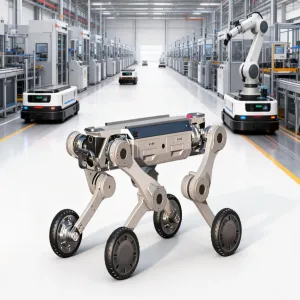
Wheeled Medium-Sized Quadruped Robot – AI-Powered Thermal Imaging for Predictive Maintenance
Leur classification: Veneer DryerVues: 26Numéro:Temps de libération: 2025-12-26 17:13:10Wheeled Medium-Sized Quadruped Robot – AI-Powered Thermal Imaging for Predictive Maintenance
Actualités
Catégorie:
-
[Company News]Small Wheeled Quadruped Robot
2025-12-26 11:45:35 -
[Company News]China-Made Quadruped Robots Reach Global Buyers as Demand fo...
2026-01-08 08:09:14
Affaire
Catégorie:
Aucun résultat de recherche!
Vidéo
Catégorie:
Aucun résultat de recherche!
Téléchargement
Catégorie:
Aucun résultat de recherche!
Recrutement
Catégorie:
Aucun résultat de recherche!
Produits recommandés
Aucun résultat de recherche!




 Téléphone